The Margin Optimization Cycle in the Automotive Aftermarket
How dynamic pricing, price elasticity and growing price differences across Europe are reshaping the Independent Automotive Aftermarket (IAM).
Not that long ago, annual price updates were standard practice in the automotive aftermarket. In some countries and parts of the market, this is still the case. Across much of Europe, however, the situation has changed dramatically.
Today, price updates can arrive monthly, weekly or even daily.
Combined with years of strong economic conditions, better access to pricing data and increasingly sophisticated pricing technology, this development opened the door to margin optimization across the entire Independent Automotive Aftermarket (IAM) distribution chain.
The larger IAM suppliers moved first. Smaller suppliers and wholesalers followed.
But after years of optimizing prices and margins, the European aftermarket may now be entering a new phase of the cycle.
What Is Margin Optimization?
When you break margin optimization down to its core principle, it is relatively simple:
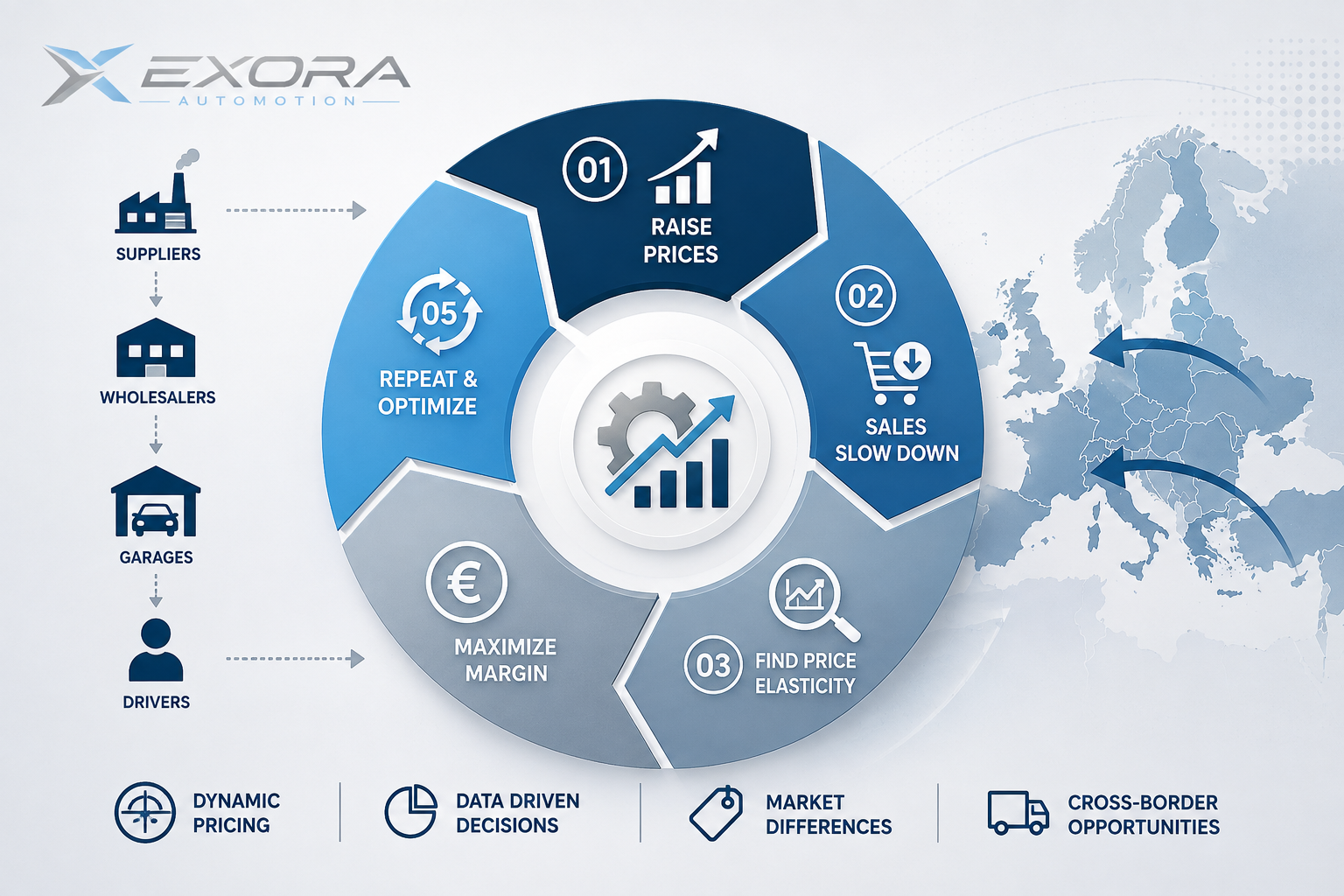
Increase the price until you begin to see a negative impact on sales volume.
In professional pricing terms, this is closely related to price elasticity: understanding how demand changes when the price of a product changes.
For many years, aftermarket pricing was influenced by relatively simple benchmarks. One common rule of thumb was that an aftermarket part should be priced at approximately 85% of the equivalent OE price.
That approach is becoming increasingly outdated.
Modern pricing strategies are much more focused on a different question:
What is the customer actually willing to pay?
With better data, pricing engines and automated price management, companies can answer that question at SKU, brand, customer and market level. As a result, pricing has become far more dynamic.
Pricing Engines Changed the Market
As we started building and working with pricing engines, we also gained much greater insight into the pricing strategies of IAM suppliers.
One particularly interesting observation was how closely supplier pricing strategies could follow one another.
Many IAM suppliers were working with similar market and pricing information, including data originating from the same German pricing-data sources. As a result, pricing movements across suppliers frequently moved in the same direction.
And during a strong market, that direction was predominantly upward.
A supplier increased its prices. Competitors followed. The market absorbed the increase, creating room for another optimization round.
This effectively created a margin optimization cycle.
Margin Optimization Moved Down the Distribution Chain
Suppliers were not the only companies looking for additional margin.
Large automotive parts wholesalers increasingly introduced their own pricing optimization strategies. This meant that margin was being optimized at multiple stages of the distribution chain.
The supplier optimized its selling price.
The wholesaler then optimized its price to the garage.
Over multiple optimization cycles, the final net price paid by the garage gradually moved closer to the maximum level the market was willing to accept.
During periods of economic growth and relatively strong demand, this model worked.
But economic conditions do not remain constant.
The European Aftermarket Is Entering a Different Phase
We are now seeing a different environment.
Economic growth has cooled, operating costs remain high, and both businesses and consumers are paying much closer attention to what products and services cost.
At the same time, years of margin optimization have contributed to substantial differences in automotive aftermarket net prices between European markets.
In some cases, we now observe net price differences exceeding 30% within the EU for comparable products.
That creates an obvious commercial opportunity.
If the same product can be purchased significantly cheaper in one European market than another, companies have an incentive to source across borders.
The result is a growing East-to-West flow of automotive aftermarket products within Europe.
The Pricing Paradox for IAM Suppliers
IAM suppliers are generally well aware of these differences.
The problem is that correcting them is far more difficult than identifying them.
Reducing prices in higher-priced markets directly impacts margin. Increasing prices substantially in lower-priced markets can result in lost sales, particularly when competitors, wholesalers and parallel importers can offer alternatives.
Suppliers therefore face a pricing paradox.
The margin optimization strategies that successfully increased profitability during stronger economic conditions may now be contributing to cross-border competition and changing product flows.
A price difference that was once simply a local market characteristic becomes much more difficult to maintain when customers have access to better pricing information and increasingly efficient European sourcing networks.
From Margin Optimization to Margin Protection
This could mark the beginning of the next stage in European aftermarket pricing.
For years, the primary question was:
How much further can we increase the price without losing volume?
The next question may become:
How do we protect margin without making cross-border sourcing more attractive?
That requires a more sophisticated approach than simply raising or lowering prices.
IAM suppliers and wholesalers increasingly need to understand price elasticity, competitive positioning, cross-border price differences, customer behaviour and net transaction prices simultaneously.
The companies that can combine these elements will be in a much stronger position to manage the next phase of the margin optimization cycle.
Because ultimately, margin optimization is not about achieving the highest possible price.
It is about finding the price that delivers the best sustainable margin without creating the conditions for customers to buy somewhere else.