Article Returns: A Costly Challenge in the Independent Automotive Aftermarket
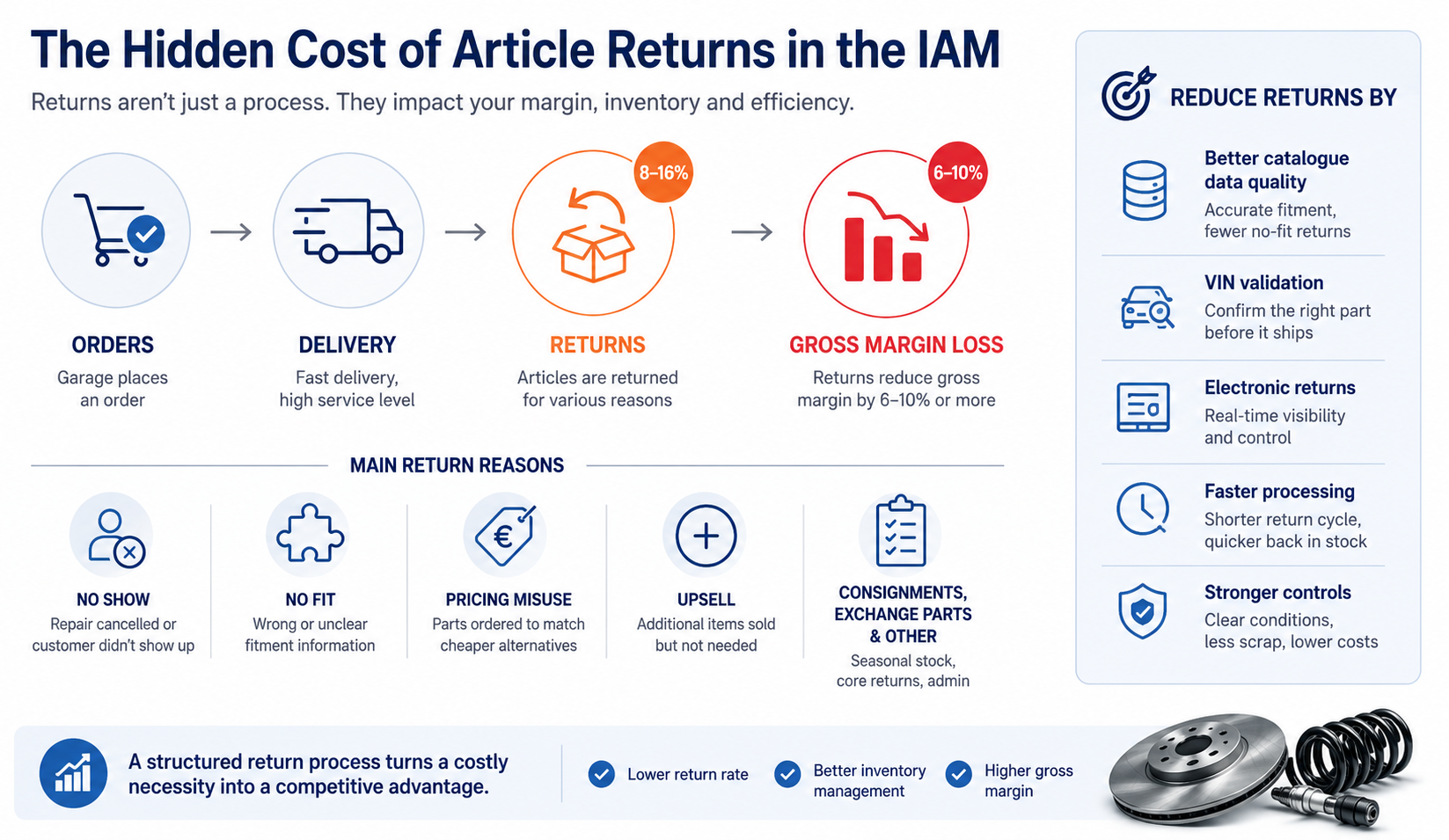
Article returns are one of the biggest hidden costs in the Independent Automotive Aftermarket (IAM). Across regional distributors, return rates typically range from 8% to 16%. Based on conservative activity-based costing, returns reduce gross margins by at least 6%, and in many businesses the impact can reach 10% or more.
These figures make returns a major profitability issue. The good news is that most returns can be reduced through better data, improved processes, and clear operational controls.
Understanding the Main Return Reasons
Before reducing returns, it is essential to understand what causes them. In most IAM businesses, returns can be grouped into the following categories:
- No show
- No fit
- Pricing misuse
- Upsell
- Returned consignments, exchange parts, and other administrative returns
Besides the reason for the return itself, the return process has a significant impact on total costs. Key process elements include:
- Electronic versus manual processing
- Return intervals
- Process controls
Let’s look at each of these in more detail.
No Show
A repair is cancelled because the customer does not arrive at the garage. In many cases, there is little that can be done about genuine no-shows.
However, there is another growing trend. Some garages use distributors as a temporary parts warehouse. They order a part for immediate availability, then purchase the same part online at a significantly lower price—sometimes up to 30% cheaper—and return the original part the next day. As price differences continue to increase, this practice is becoming more common.
Action item:
Implement a structured return reason registration process and monitor no-show returns against benchmark percentages. This is relatively easy to implement and provides valuable management information.
No Fit
“No fit” remains the most common reason for returns. In many cases, the catalogue cannot identify one unique part number, so the garage orders multiple options and returns the unused item.
This is a well-known IAM challenge, but it is also an opportunity to differentiate your business through better catalogue quality and customer support.
Many wholesalers and garages still rely on manual checks using tools such as Partlink. While this helps, it is time-consuming and does not build confidence in your catalogue.
Action items
There are several effective solutions:
- Enrich TecDoc data with OE data within the search engine. This significantly improves part identification. Although the initial investment is substantial, it becomes highly cost-effective for larger wholesalers.
- Basket or order alerts. Generate an alert when multiple parts with the same fitment are ordered for the same vehicle, allowing customer service to verify the order before dispatch.
- Historical return risk alerts. Use historical return data to identify orders with a high probability of being returned.
- Automated VIN validation. Integrate an external VIN API to validate OE numbers before shipment. Depending on the provider, costs range from approximately €0.08 to €0.80 per validation. While these costs can accumulate, the reduction in return costs typically results in a positive ROI, while garages benefit from a more reliable catalogue.
Pricing Misuse
Pricing misuse is becoming increasingly common.
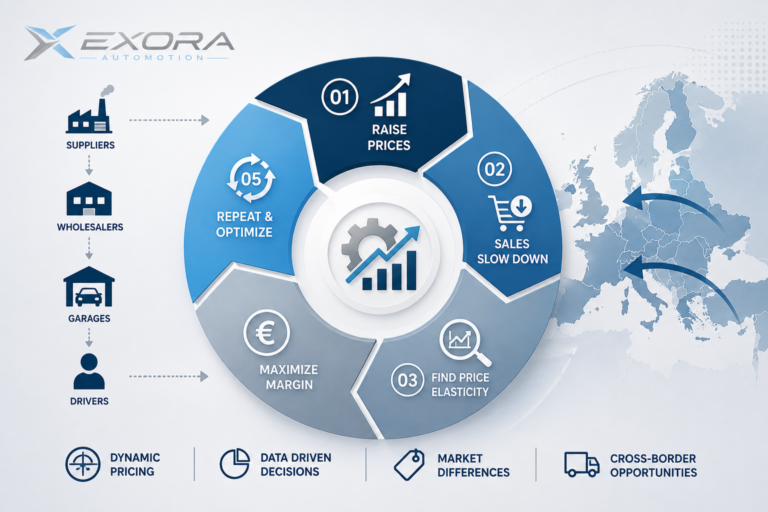
As Eastern European wholesalers continue expanding into Western Europe, garages can often purchase identical parts at prices up to 30% lower while still receiving next-day delivery.
The garage orders the urgently needed part from its regular distributor, completes the repair, and then returns the cheaper replacement received the following day from the lower-cost supplier.
Action item:
Use data analytics to identify customers with unusually high return behaviour. Benchmarking customer return patterns makes this relatively straightforward to implement.
Upsell
Upselling has a legitimate commercial purpose but also increases return costs.
A typical example is supplying brake discs together with brake pads. While this can increase sales and improve customer service, unused products are often returned.
Action item:
Clearly identify upsell-related returns in your return administration. Separating these from other return reasons provides a much better understanding of actual return costs and commercial effectiveness.
Returned Consignments and Other Returns
Some returns are operational rather than commercial.
Examples include:
- Seasonal battery consignments where unsold winter stock is returned.
- Exchange parts collected when selling remanufactured products. In some systems these are incorrectly recorded as product returns.
Action item:
Clearly distinguish between commercial returns, consignment returns, exchange cores, and administrative returns. Accurate classification provides much better reporting and supports better decision-making.
Optimising the Return Process
The return process itself often determines a significant portion of the total cost. Even when return percentages remain unchanged, process improvements can substantially reduce handling costs.
Electronic vs. Manual Processing
Although electronic return processing is becoming more common, many distributors still rely on manual procedures. Parts are simply placed in a return crate and collected by the delivery driver during the next delivery.
This creates delays and limits visibility.
Action item:
Move to an electronic return process where garages register returns before collection. This immediately provides visibility of incoming stock, prevents unnecessary replenishment, and improves inventory planning.
Return Interval
Some garages still return parts only once a week.
While weekly invoicing was once common, most distributors have moved to daily invoicing. The same principle applies to returns.
The longer parts remain at the garage, the longer they remain unavailable for resale.
Action item:
Implement a direct return process. The sooner returned goods are back in stock, the sooner they become saleable again.
Process Controls
Typically, 5% to 10% of returned products cannot be resold and must be scrapped.
Many of these losses are preventable.
Returns should comply with clearly defined conditions, including:
- Clean products
- Unopened packaging
- Complete packaging
- No transport damage
The delivery driver performs the first inspection, followed by warehouse personnel upon receipt.
Manufacturers generally reject damaged or opened packaging, so garages should fully understand these requirements.
Action item:
Define and consistently enforce clear return conditions. Good service remains important, but flexibility has a cost. Customers should understand the value of this service, especially when price discussions arise.
Conclusion
Returns are an unavoidable part of the IAM business, but their cost is often underestimated.
Poor visibility, slow return processes, weak controls, and inaccurate return classifications all contribute to unnecessary costs.
During operational reviews, we regularly find products waiting for return at garages while replacement stock has already been replenished throughout the supply chain. Once the original parts finally return, they often create surplus inventory and additional handling costs.
We also frequently see products accepted for return that should have been rejected because of damaged packaging or poor handling. These items are eventually scrapped, creating direct financial losses.
A structured, electronic return process provides the visibility needed to reduce return percentages, improve inventory management, and protect margins.
The industry is changing. New generations of garage owners are increasingly comfortable with digital processes, competitors are introducing stricter return policies, and price pressure continues to grow.
Distributors that invest in return management today will improve customer service, reduce operational costs, and strengthen their competitive position.
Key Takeaways
- Return rates of 8–16% can reduce gross margins by 6–10% or more.
- Measure return reasons before trying to reduce them.
- Improve catalogue quality to reduce “no fit” returns.
- Use data analytics to detect pricing misuse.
- Move to electronic return registration.
- Shorten return lead times.
- Apply consistent return quality controls.
- Use return data to continuously improve both processes and profitability.