The Data Uniformity Learning Curve
The Data Uniformity Learning Curve: The Hidden Risk in ERP Integrations and Company Mergers
For many organizations, data uniformity is the problem everyone knows about—but few truly solve. After working on several large-scale integration projects, one lesson stands out: poor data uniformity is one of the most underestimated risks in mergers, acquisitions, and ERP integration projects.
This is especially true for companies that have grown through an active mergers and acquisitions (M&A) strategy. Even among multi-billion-euro organizations, the root cause is often left untouched.
The Quick Fix That Becomes a Long-Term Problem
ERP integration projects are typically owned by IT departments, and understandably so. Their objective is clear: make the systems work together as quickly as possible.
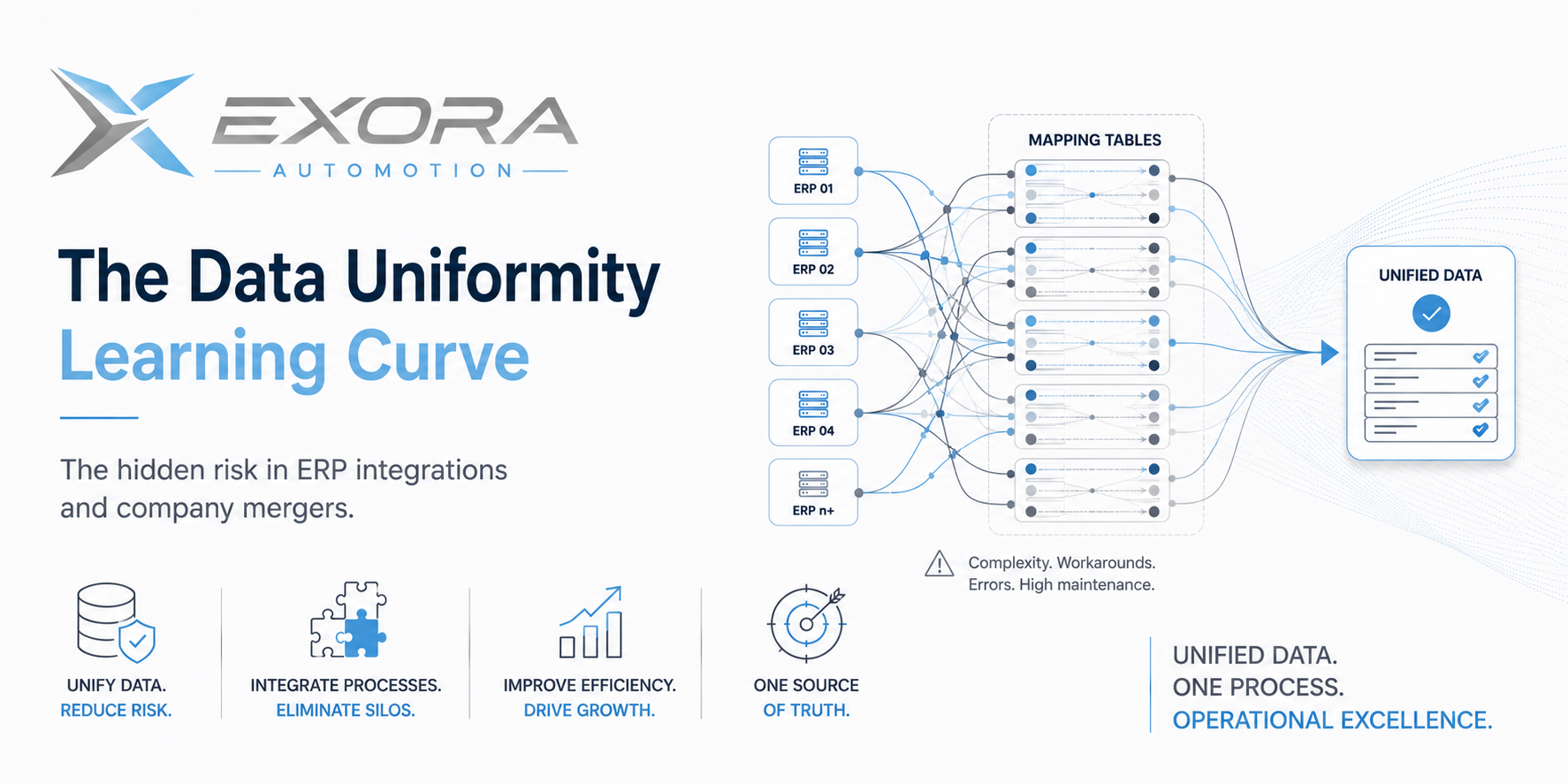
To achieve that, IT teams create mapping tables between customers, products, hierarchies, discount structures, suppliers, and countless other data objects. Initially, this works.
The first two ERP systems become connected. It may be fragile and require significant maintenance, but the business can continue operating. The project is considered a success, and everyone moves on.
Until the next acquisition.
When Complexity Starts to Explode
As ERP system number three, four, and five are added, the number of mapping tables grows exponentially. Workarounds multiply, dependencies become harder to understand, and maintaining integrations becomes increasingly expensive.
Eventually, IT support desks become overwhelmed with data-related issues. In several organizations we observed that more than 80% of support tickets were directly or indirectly related to inconsistent master data.
At the same time, AI and automation promise to connect everything digitally. While the technology works, it often builds on inconsistent data, creating an increasingly decentralized black box rather than solving the underlying problem.
Mapping Tables Have Their Limits
One of the biggest lessons from these projects is that mapping cannot solve process differences.
We repeatedly encountered issues with:
- Customer master data
- Product information
- Discount structures
- Returns processes
- Surcharges and pricing logic
On paper, the processes looked similar. In reality, each ERP system reflected different business rules developed over many years.
The integration worked for perhaps 95% of scenarios.
The remaining 5% caused disproportionate operational problems because the critical business exceptions were hidden in countless small process differences.
As the saying goes, the devil is in the details.
Why Standardization Rarely Happens
The obvious answer seems simple: move every company to one standard process.
In practice, very few organizations actually do this.
One reason is that project teams often lack deep operational knowledge of how work is performed on the shop floor. Activities may appear identical across business units but are often executed differently because of local history, customer requirements, or legacy systems.
Without understanding these differences, true process standardization becomes almost impossible.
What Successful Companies Do Differently
The organizations that successfully integrated multiple ERP systems shared one important characteristic:
They started standardizing from the very first integration.
Instead of endlessly expanding mapping tables, they invested early in:
- Master Data Management (MDM)
- Product Information Management (PIM)
- Customer Relationship Management (CRM)
- Dedicated data governance teams
More importantly, these initiatives were not purely IT-driven.
They were sponsored by CEOs and executive leadership who recognized that high-quality, standardized data is a strategic asset—not just an IT issue.
Customer data, product data, pricing structures, and discount models were standardized gradually but consistently.
Today, these companies are far better positioned to achieve operational excellence. They operate leaner organizations, require fewer manual interventions, and remain highly competitive.
The Hidden Cost of a “Successful” Integration
One of the biggest dangers is that a technically successful ERP integration can hide underlying problems for years.
Systems continue running, reports are produced, and transactions are processed.
Meanwhile, complexity keeps growing beneath the surface.
Eventually, the black box becomes too expensive to maintain. Support costs rise, process efficiency declines, and innovation slows because every new change has to navigate years of accumulated workarounds.
By that point, companies often spend millions fixing the consequences rather than addressing the original cause: inconsistent data and non-standardized processes.
The CEO’s Perspective
For CEOs, these issues often become visible through benchmarking.
Compare your organization with similar companies and ask questions such as:
- Why do we require significantly more IT staff?
- Why are our finance teams larger?
- Why do purchasing or customer service departments need more people?
- Why does every process require so many manual corrections?
These are often indicators of underlying process complexity and poor data uniformity.
Improving data consistency is neither fast nor easy. It requires investment, leadership, and patience.
But organizations that tackle the root cause early avoid years of unnecessary complexity and create a much stronger foundation for future growth.
Final Thoughts
Data uniformity is rarely the most visible challenge during a merger or ERP integration—but it is often the most expensive one in the long run.
Every mapping table added today can become technical debt tomorrow.
The companies that outperform their competitors are not necessarily those with the most advanced ERP systems. They are the ones that invest early in standardized master data, consistent business processes, and strong data governance.
In the end, operational excellence starts with data that everyone can trust.