Tomorrow’s IAM Wholesale ERP: What Will It Look Like?
The Independent Automotive Aftermarket (IAM) is becoming more competitive, digital and complex every year. For automotive wholesalers, this raises an important question:
If you were selecting a new ERP today, should you still migrate to a traditional ERP platform?
The answer depends partly on the size and complexity of your business. But there is a bigger issue to consider.
Yesterday, automation was mainly a process facilitator. Today, automation and digital capability are strategic assets. And tomorrow, they may determine which IAM wholesalers can compete successfully in an increasingly e-commerce-driven and multichannel market.
That makes it worthwhile to examine how well today’s ERP solutions actually fit the specific requirements of an IAM automotive wholesaler.
What Does an IAM Wholesale ERP Need to Support?
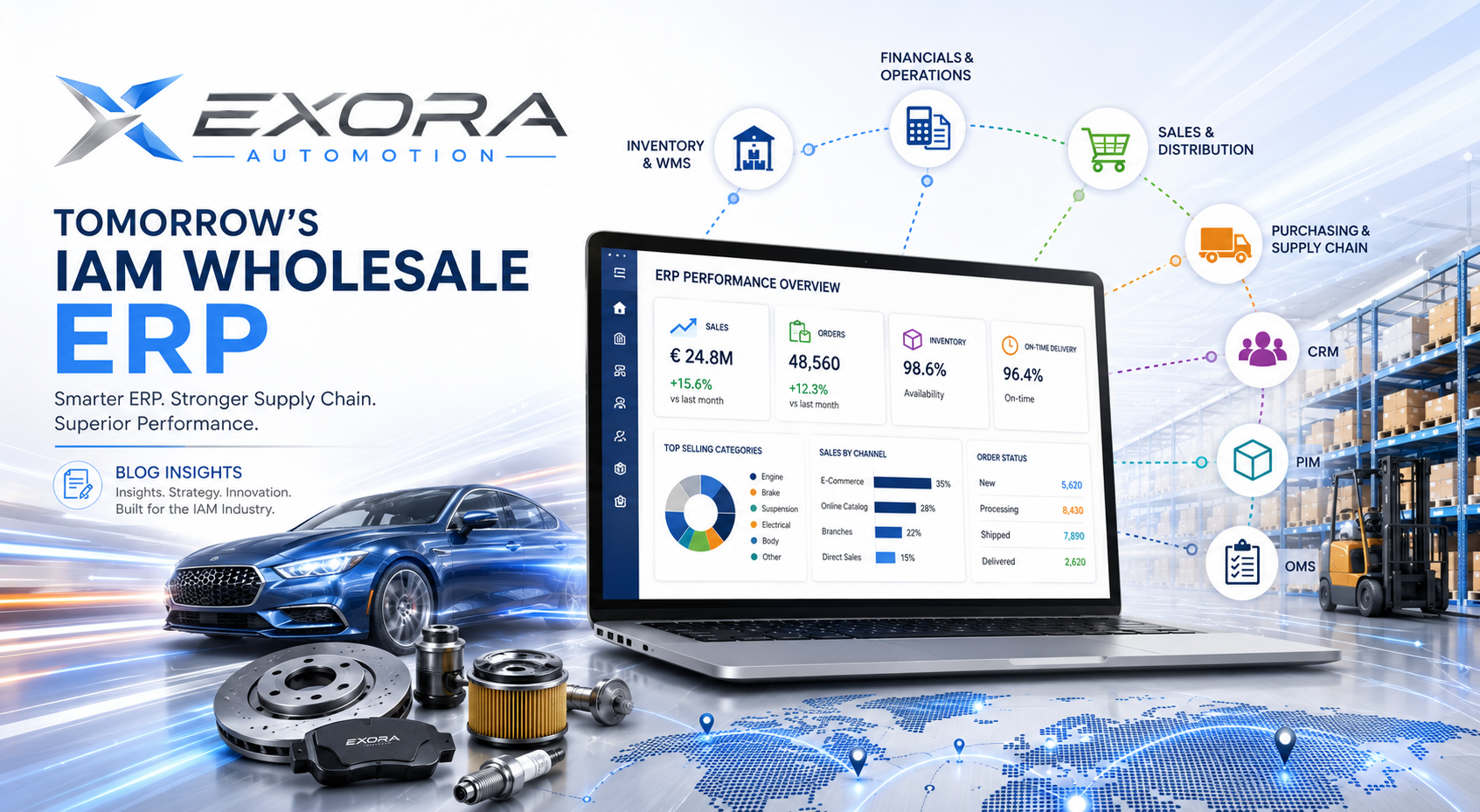
If we break down the typical ERP landscape of an automotive aftermarket wholesaler, we can divide it into four major areas:
- Core financials and operations
- Inventory and warehouse management
- Sales and distribution
- Purchasing and supply chain
Let’s look at each area and, more importantly, where traditional ERP systems fit — and where they often fall short.
1. Core Financials and Operations
Core financial processes are where traditional ERP systems generally perform well.
A modern ERP should align with local legislation while automating as much administrative work as possible. Document scanning, electronic document processing, automated workflows and management by exception should make financial administration an efficient, relatively low-FTE part of the business.
This is becoming increasingly standardized.
For an IAM wholesaler, therefore, core finance is important — but it is unlikely to be the area where you create a major competitive advantage.
The real differentiation starts elsewhere.
2. Inventory and Warehouse Management
Inventory and warehouse management in the automotive aftermarket is already more challenging.
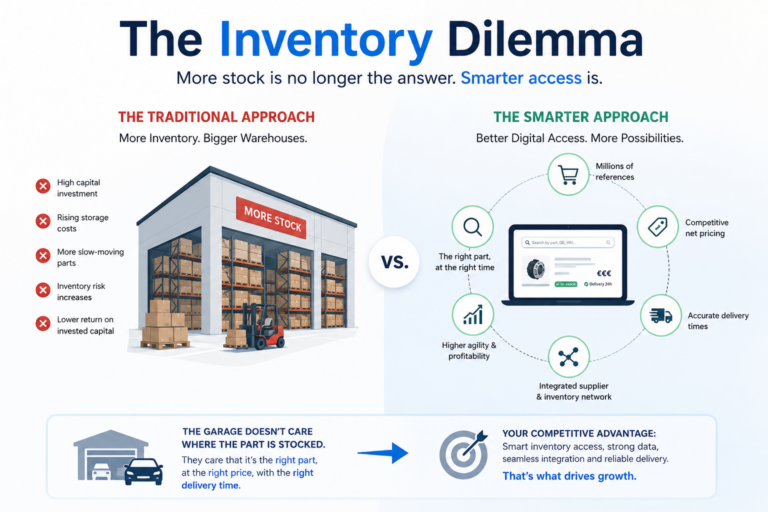
Here, many generic ERP systems provide a poor fit. Their standard inventory functionality often needs extensive customization or support from specialized inventory optimization applications such as Slim4.
Basic warehouse management may be handled adequately within an ERP. But as volumes, complexity and performance requirements increase, standard ERP functionality can quickly reach its limits.
This is why specialized Warehouse Management Systems (WMS) such as Manhattan, Sterling and various strong local solutions are often introduced. Depending on the operation, these systems can take over selected warehouse processes or almost the complete warehouse operation.
For larger IAM wholesalers, the question therefore shouldn’t necessarily be:
“Which ERP can do our warehouse management?”
A better question may be:
“Which architecture allows our ERP and specialized WMS to work together effectively?”
That is an important difference in thinking.
3. Sales and Distribution
Sales and distribution is where the specific complexity of the automotive IAM wholesale business becomes particularly visible.
Our industry is famous for highly complex discount and pricing matrixes combined with assortments that can easily reach more than one million product references — and significantly more for the largest market players.
Only a limited number of traditional ERP systems can deliver net price calculations at the speed and scale required by a modern, e-commerce-driven automotive wholesaler.
Other ERP solutions require additional systems, heavy customization or compromises that ultimately result in a poor user or customer experience.
In our experience, pricing performance is often underestimated during ERP selection.
Yet consider what happens in an online environment: a customer searches for a part, and your systems may need to determine availability, customer-specific pricing, discounts, alternative products, sourcing options and delivery possibilities almost instantly.
That is no longer simply an ERP transaction. It is a core part of your digital customer experience.
CRM Is Becoming Equally Important
Another weakness of many traditional ERP platforms is customer management.
The standard ERP “customer card” often lacks the depth required for professional customer management, segmentation and sales activities.
As a result, a specialized CRM (Customer Relationship Management) platform has become a necessary part of many modern IAM architectures.
We are seeing this approach used increasingly across the market.
4. Purchasing and Supply Chain
The basic purchasing requirements of an IAM wholesaler can be supported by most ERP systems — as long as the operation does not become too complex.
Traditional sourcing processes generally aren’t the problem.
Automated intelligent sourcing is.
Imagine an online order where the system must choose between multiple suppliers based on parameters including:
- Product price
- Availability
- Lead time
- Transportation cost
- Supplier conditions
- Customer delivery requirements
Now imagine that decision has to be made within a split second while supporting your online catalogue and e-commerce operation.
This is where traditional ERP functionality frequently falls short.
The IAM Last Mile Creates Another Challenge
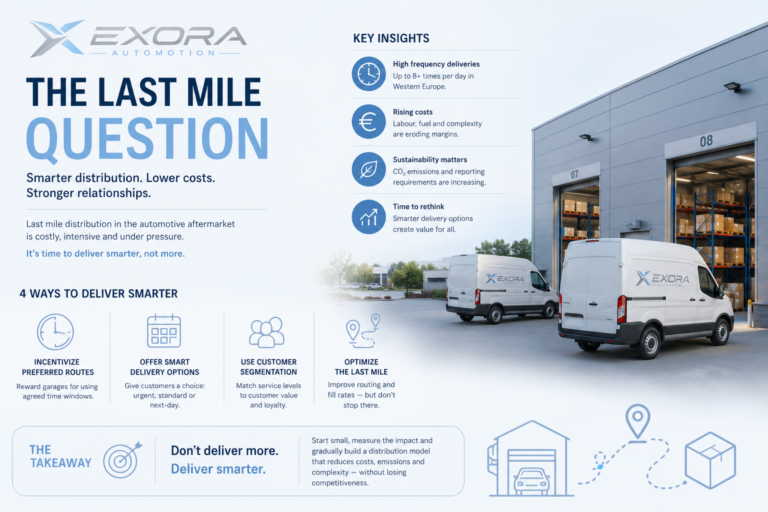
The automotive aftermarket also has highly specific supply-chain requirements, particularly around last-mile distribution.
IAM wholesalers can operate combinations of milk runs, pizza runs, ad-hoc deliveries, overnight replenishment and multiple distribution steps between a central distribution centre, depots and points of sale.
Few, if any, generic ERP solutions can fully support this complexity out of the box.
And that brings us to a fundamental question about the future of the IAM wholesale ERP architecture:
Should we continue trying to make one ERP system do everything?
Probably not.
ERP Strategy for Smaller IAM Wholesalers
For smaller IAM wholesale organizations with limited capacity to invest heavily in e-commerce and digital development, local automotive IAM software can remain a logical solution.
Migration costs can be relatively low, and a specialized industry solution can provide the generic functionality required to operate the business effectively.
The potential disadvantage is strategic.
Such a solution may help you operate, but not necessarily help you innovate toward the multichannel business model the market increasingly demands.
For smaller wholesalers, selecting technology should therefore still start with one question: What kind of company do we want to become?
ERP Strategy for Mid-Sized IAM Wholesalers
For mid-sized IAM wholesalers that can invest both money and FTE capacity in their e-commerce future, a different architecture becomes attractive.
Rather than trying to implement one enormous ERP covering every requirement, we would recommend considering a lightweight ERP that supports the basic processes extremely well, combined with an intelligent digital layer.
That layer can provide the functionality and performance required for:
Multi-sourcing. Multi-pricing. E-commerce. High-performance transactions.
Add straightforward cloud-based CRM and PIM (Product Information Management) solutions, and a mid-sized wholesaler can create a powerful and relatively cost-efficient digital architecture.
More importantly, this architecture can provide the agility needed to move faster than competitors.
ERP Strategy for Large IAM Wholesalers
The largest players in today’s IAM market will understandably continue to consider the major ERP platforms positioned at the top end of analyst evaluations.
For a large organization, choosing an established enterprise platform can appear to be the safest decision.
But “safe” doesn’t necessarily mean simple — or cheap.
Large IAM organizations can end up investing millions of euros in customization, integrations and performance improvements to make a generic enterprise ERP capable of supporting automotive aftermarket requirements such as:
- 10+ million articles
- Complex customer-specific pricing
- Intelligent multi-sourcing
- High-performance e-commerce
- Automotive last-mile distribution
- Complex purchasing and supply-chain processes
Instead of forcing all of this complexity into the ERP, large organizations should seriously consider a best-of-breed architecture.
A strong OMS (Order Management System) or DOM (Distribution Order Management) can orchestrate complex ordering, sourcing and supply-chain processes.
A solid master-data architecture can manage supplier, customer and product data.
A specialized WMS (Warehouse Management System) can support and optimize internal warehouse processes.
CRM can own the customer relationship.
PIM can manage rich product information.
And the ERP can concentrate on the processes it does best.
The Future IAM ERP Is an Ecosystem, Not a Monolith
This may be the biggest change in how we should think about ERP.
Tomorrow’s IAM wholesale ERP may not actually be one ERP.
Instead, it will increasingly be an ecosystem of specialized applications connected through a strong digital architecture.
The traditional ERP remains important, but its role changes.
Rather than being the system expected to control virtually every business process, it becomes one of several core components within a broader technology landscape.
The competitive advantage then moves toward the intelligent layer connecting those systems — where pricing, sourcing, customer experience, product information, inventory, orders and logistics come together.
Tomorrow’s IAM Champions Are Investing Today
The automotive aftermarket is moving quickly. Tomorrow’s champions will be the companies investing in their digital capabilities today.
Whether you are a small, mid-sized or large IAM wholesaler, the size of your technology budget is not the only question.
You need a clear vision of where you want your business to go and how you want it to operate.
Do you want to remain a traditional, FTE-driven organization — the business of “the man with the phone”?
Or do you want to develop into an agile, multichannel automotive aftermarket wholesaler, connecting customers, suppliers, products, inventory and logistics digitally while delivering greater speed and convenience to the garages around you?
That strategic decision should come before your ERP decision.
Because the most important question is no longer:
“Which ERP should we buy?”
It is:
“Which digital architecture will allow us to compete tomorrow?”