
The Inventory Dilemma: Why More Warehouse Space Is Not the Answer
The automotive Independent Aftermarket (IAM) is facing an inventory dilemma. In many of our meetings and interviews, we encounter these challenges firsthand and discuss strategic solutions to address them.
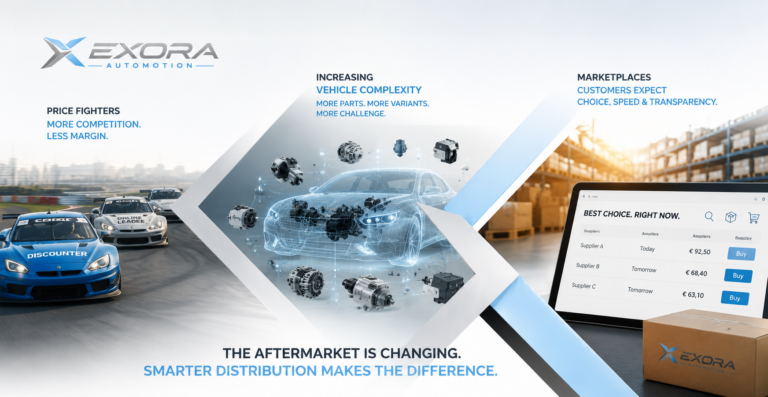
Increasing vehicle complexity, a growing average vehicle age, a rapidly expanding number of vehicle types and references, and increasing online competition are fundamentally changing the economics of automotive parts distribution.
Yet many traditional IAM wholesale companies — from businesses with millions in turnover to organisations generating billions — continue to respond in exactly the same way:
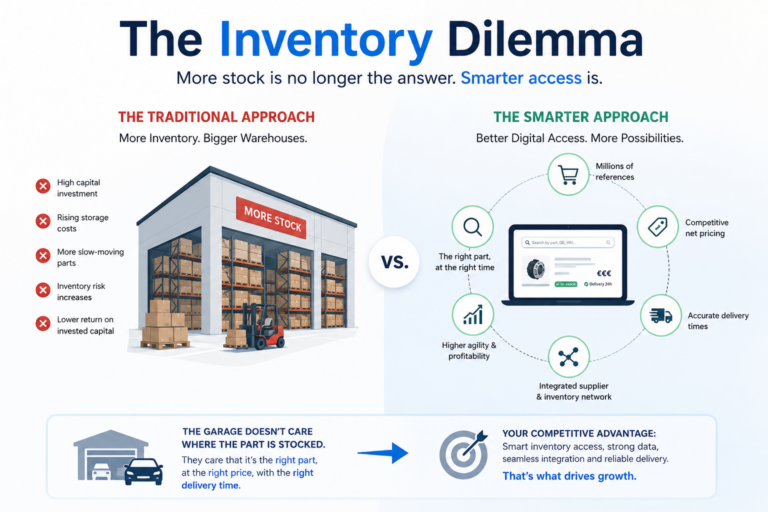
Build bigger warehouses. Invest in more warehouse automation. Fill those warehouses with more inventory.
It is understandable. This strategy has worked for decades. Warehouses are physical, measurable and impressive. A highly automated, 12-metre-high facility filled with automotive parts creates a visible sense of scale and capability.
But does it still create the best return on investment?
The Growing Cost of Slow-Moving Inventory
As vehicles remain on the road longer and the diversity of the European car parc continues to increase, distributors need access to an ever-growing number of part references.
The problem is simple: not every additional reference becomes a fast-moving product.
Quite the opposite.
As the assortment expands, the long tail of slow-moving automotive parts grows with it. Filling large, expensive warehouses with an increasing percentage of slow-moving inventory ties up capital, consumes warehouse capacity and increases inventory risk.
That raises an important strategic question for automotive aftermarket distributors:
Should the next million be invested in more physical inventory — or in better digital access to inventory?
From Warehouse Capacity to Digital Capability
For established warehouse distributors still following the traditional model, we believe the priority should increasingly shift towards strengthening digital capabilities.
That means investing in:
- e-commerce platforms;
- product and vehicle data management;
- supplier and distributor integrations;
- real-time stock availability;
- intelligent sourcing and routing;
- accurate net pricing;
- reliable delivery-time information.
Why?
Because your next competitor may not have a bigger warehouse.
It may be an online distributor, an Eastern European supplier or even a local competitor with a smarter digital platform.
These companies can gradually take market share by giving garages exactly what they are looking for: millions of searchable references, competitive net pricing, accurate availability and clear delivery times.
The Garage Does Not Care Where the Part Is Stocked
This is perhaps the most important change.
The garage does not necessarily care — and often cannot even see — whether an article is physically stocked in your own warehouse.
What matters is whether the correct part can be found, whether the price is competitive and whether the promised delivery time is reliable.
A distributor with strong digital integrations can therefore present an assortment far larger than the inventory physically stored in its own facilities.
Your warehouse becomes part of the solution, but no longer needs to be the entire solution.
Leading distributors are already moving in this direction. They are integrating more suppliers, more inventory sources and more fulfilment options into their digital platforms.
The result is an almost endless digital assortment supported by transparent net pricing and predictable delivery times.
Digital Strength Will Become the Growth Engine
The future automotive aftermarket distributor will not necessarily be the company with the most inventory.
It could be the company with the best access to inventory.
Traditional warehouse wholesale will remain extremely important. Fast-moving parts still need to be close to the customer, and strong logistics will continue to be a major competitive advantage.
But the warehouse increasingly becomes one supply source within a much broader digital supply network, rather than the sole source of supply.
That requires a different investment philosophy.
Instead of asking:
“How much more inventory can we stock?”
Distributors should increasingly ask:
“How much more inventory can we intelligently access, integrate, price and deliver?”
Supplier Relationships Need to Change Too
This transformation also requires a different relationship between IAM distributors and automotive parts manufacturers.
Traditionally, suppliers have encouraged distributors to commit to large inventories and substantial stock investments.
At the same time, many of those suppliers also support the online competitors that are challenging traditional distributors.
That creates a strategic contradiction.
Distributors should therefore reconsider supplier agreements and focus not only on purchasing conditions and stock commitments, but also on data access, digital connectivity, availability, fulfilment options and integration capabilities.
In the next phase of the automotive aftermarket, the strongest supplier relationship may not simply be the one offering the best purchasing conditions.
It may be the one providing the best digital connection to its inventory.
Inventory Is Still Important — Access Is More Important
The inventory dilemma is not about choosing between warehouses and digital platforms.
Both are necessary.
The real challenge is determining where physical inventory creates a genuine competitive advantage and where digital integration provides a better return on invested capital.
For fast-moving products, local availability remains critical.
For the long tail, intelligent digital sourcing may increasingly be the better economic model.
The winners in automotive aftermarket distribution will therefore combine strategic physical inventory, strong logistics, high-quality data, powerful e-commerce and deeply integrated supply networks.
The competitive advantage of tomorrow will not be measured only by the number of pallets in your warehouse.
It will be measured by how effectively you can give your customer access to the right part, at the right price, with the right delivery time — regardless of where that part is physically stocked.