Pragmatism in Today’s AI Race
Artificial Intelligence is everywhere. Every conference, board meeting, and strategy session seems to revolve around AI. Yet after speaking with numerous business owners and C-level executives in the Independent Aftermarket (IAM), we’ve noticed a recurring pattern.
Everyone wants to leverage AI.
Everyone is afraid of missing out.
But almost everyone is unsure where to begin.
The AI race has become a race to start, rather than a race to build sustainable business value.
The Missing Foundation of Successful AI Projects
During our conversations, we rarely start by discussing AI itself.
Instead, we ask questions about data.
- How is your data structured?
- What data governance processes are already in place?
- How reliable is your existing data?
- What AI initiatives have you already explored?
The answers reveal a common challenge.
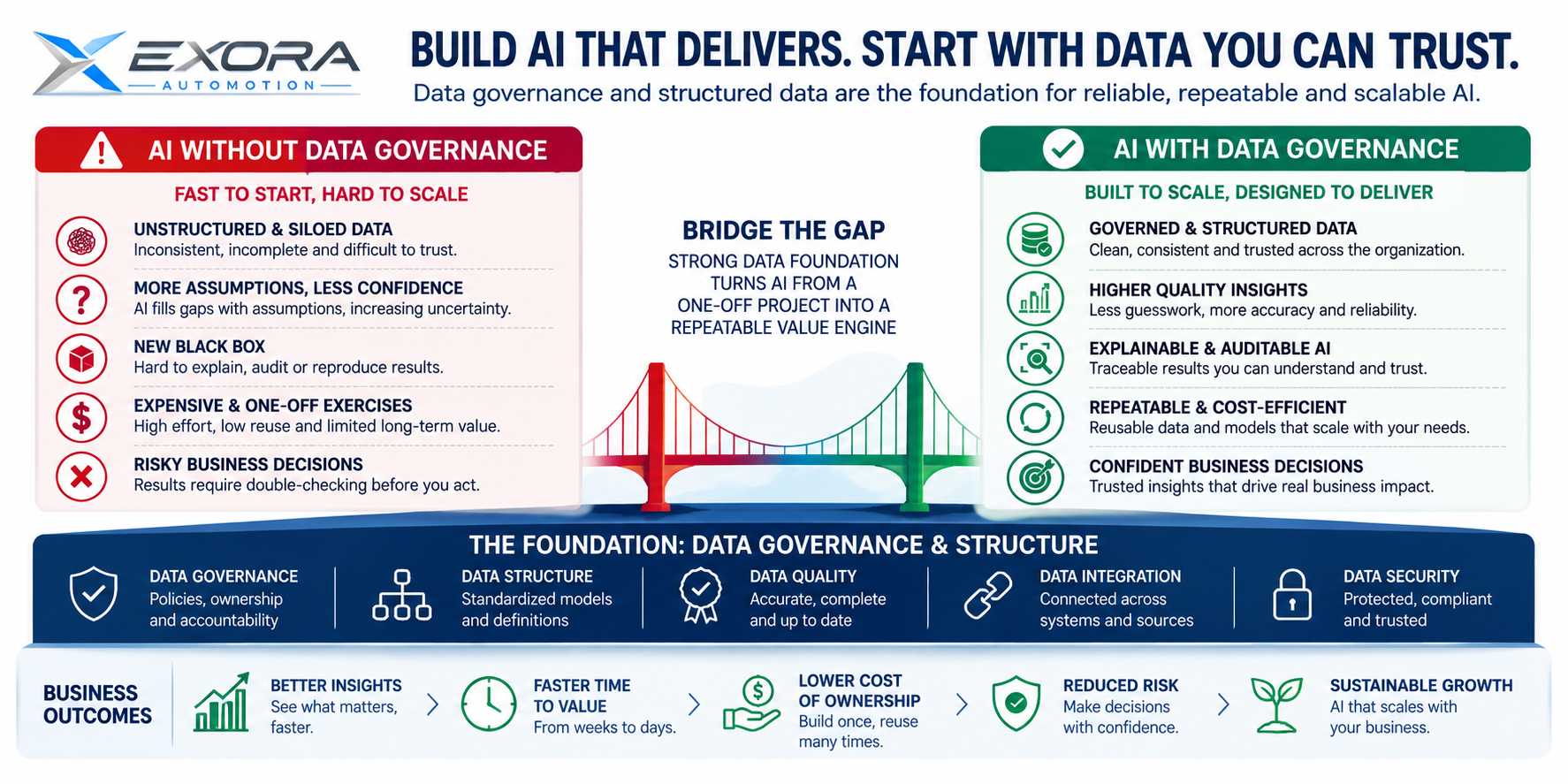
Most companies eager to start with AI simply do not yet have the data foundation required for AI to deliver continuous business value.
Why Many AI Projects Fail to Scale
Many organizations have already experimented with AI-powered reporting, trend analysis, dashboards, and business insights.
The first results are often impressive.
AI can identify patterns in enormous amounts of unstructured information, generate useful reports, and uncover insights that would otherwise remain hidden.
But after the initial excitement, companies encounter the same problem:
Their data itself becomes the bottleneck.
Without proper data governance and structured data, AI projects become expensive, difficult to maintain, and impossible to scale.
Instead of creating a reusable capability, organizations create one-off solutions that require significant effort every time they need new insights.
“Garbage In, Garbage Out” Still Applies to AI
The old saying has never been more relevant.
Garbage in equals garbage out.
Yes, modern AI can extract value from unstructured data.
It can identify:
- Trends
- Patterns
- Customer behavior
- Hidden relationships
- Valuable observations
But producing an answer is not the same as producing a reliable answer.
When AI operates primarily on poorly governed or inconsistent data, the number of assumptions increases.
As assumptions grow, confidence decreases.
Eventually, organizations risk creating a new kind of black box.
Don’t Replace One Black Box with Another
One of the biggest risks in today’s AI landscape is replacing manual processes with AI systems that nobody fully understands or can validate.
If AI identifies an important trend, can you explain why?
Can you trace every conclusion back to the underlying data?
Can the analysis be repeated tomorrow with consistent results?
If the answer is no, AI becomes difficult to trust for business-critical decisions.
Every important insight still requires manual verification, reducing much of the efficiency AI promised to deliver.
Data Governance Is an AI Strategy
Our experience has taught us one important lesson:
Start with data governance before starting with AI.
Design, redesign, or improve your data structures first.
Doing so delivers immediate value through:
- Higher data quality
- Better reporting
- More reliable analytics
- Consistent business insights
- Faster future AI implementations
Most importantly, it creates a foundation that allows AI initiatives to become repeatable, scalable, and cost-efficient.
A Different Approach to AI in the Automotive IAM
Many AI providers simply connect their models to your existing data and start generating results.
The underlying data problems remain untouched.
We take a different approach.
With deep expertise in automotive IAM data, we work alongside our customers to improve data structures, establish governance, and create the right foundation before launching AI initiatives.
This approach requires more preparation upfront, but it leads to significantly better long-term results.
Instead of building AI on unstable foundations, we build AI on trusted, organized, and governed data.
Sustainable AI Starts with Better Data
Artificial Intelligence is not a shortcut around poor data management.
It amplifies whatever foundation already exists.
Organizations that invest first in structured data and governance will not only build better AI solutions—they will build AI solutions they can trust, repeat, and scale.
The AI race is not about being first.
It’s about building capabilities that continue to deliver value long after the hype has passed.