The Last Mile Question: Rethinking Automotive Aftermarket Distribution
In the Independent Automotive Aftermarket (IAM), last mile distribution—the final part of the distribution chain where automotive parts are delivered to the garage—is one of the most intensive and costly elements of the supply chain.
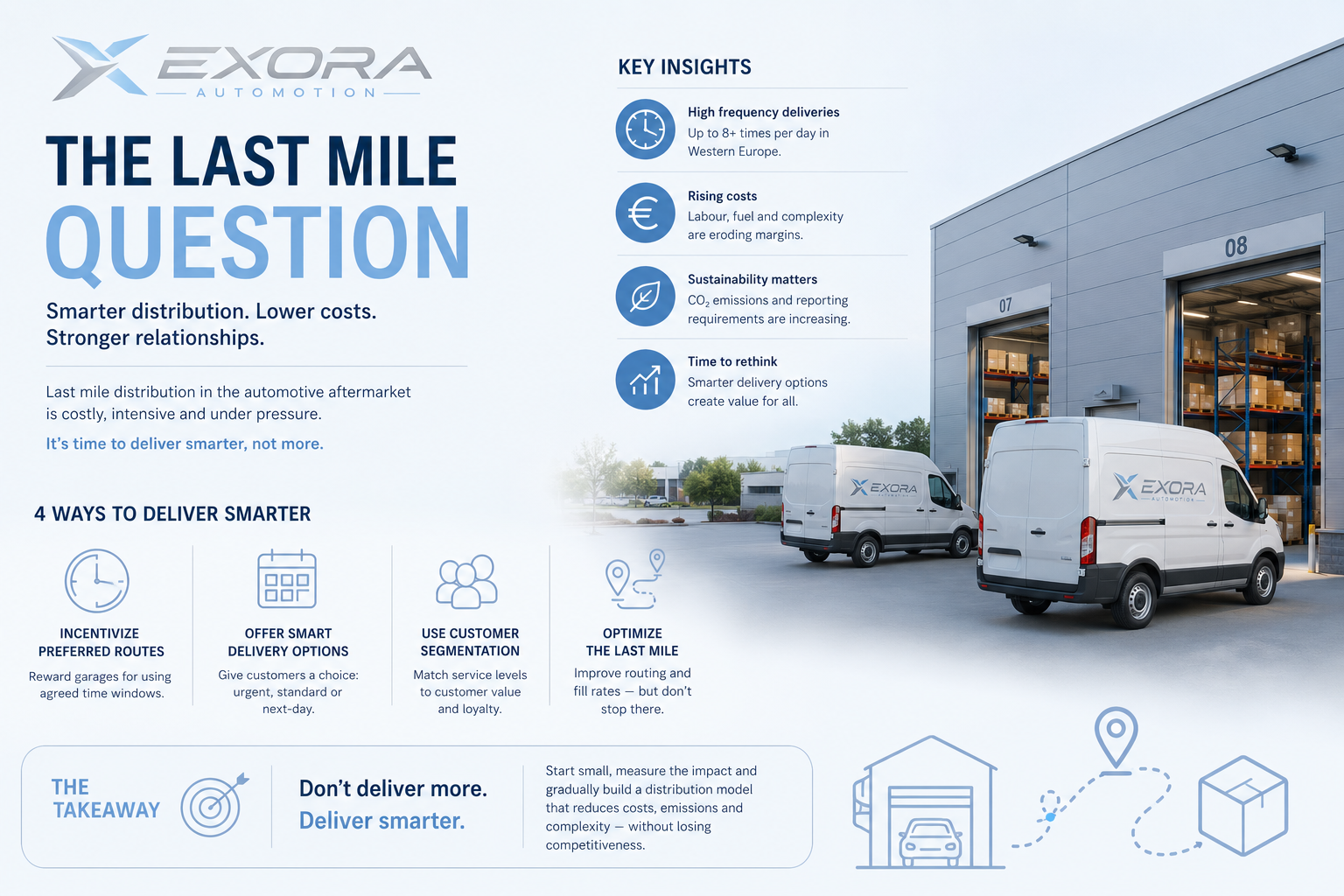
Especially in Western Europe, automotive aftermarket distributors have pushed service levels extremely far. In some markets, garages receive eight or more deliveries per day. In the UK, the model can be even more direct: you order, we drive.
When discussing distribution models in more detail, we often discover additional routes and, in some cases, even dedicated deliveries for larger customers.
This raises an important question:
How sustainable is today’s last mile distribution model—financially and environmentally?
Why Are We Still Delivering So Frequently?
In our interviews with automotive aftermarket distributors, intensive and high-cost delivery schedules almost always lead to the same explanation:
“Our competitors are doing it, so we cannot lower our service level.”
This is understandable. Fast delivery has become an important part of the competitive proposition of IAM distributors.
But there is another side to the story.
Rising labour costs, fuel prices and other operational expenses mean that intensive last mile distribution is consuming an increasing share of distributors’ margins. At some point, adding another delivery route may no longer create enough customer value to justify its cost.
The question therefore shouldn’t simply be:
How can we make our existing routes cheaper?
A better question might be:
How can we reduce unnecessary deliveries without losing competitiveness?
CO₂ Emissions Add Another Dimension
There is another development that could accelerate the discussion: companies are becoming increasingly serious about measuring and reducing their CO₂ footprint.
European sustainability reporting requirements , including the Corporate Sustainability Reporting Directive (CSRD) and national reporting requirements, are increasing awareness of the environmental impact of logistics.
Even for distributors that are not directly subject to all reporting requirements, the direction is clear. Customers, suppliers, shareholders and employees increasingly expect companies to understand and manage their environmental footprint.
For automotive aftermarket distributors, last mile delivery is an obvious area to investigate.
Every unnecessary route has both a financial cost and a carbon cost.
So how can distributors bring those costs down without simply handing a competitive advantage to someone else?
Based on what we observe in today’s market, several approaches are worth exploring.
1. Incentivize Preferred Delivery Routes
Instead of treating every delivery route equally, distributors can make specific routes more attractive.
For example, deliveries at 08:00, 13:00 and 15:00 could become preferred routes and form part of the commercial agreement with the garage.
Other delivery slots remain available, but customers are incentivized to use the preferred routes. A garage could, for instance, receive an additional bonus when an agreed percentage of its orders is delivered through these routes.
This maintains flexibility while gradually changing ordering behaviour.
The objective is not to take service away from the customer. It is to reward more efficient use of the distribution network.
2. Offer Smarter Delivery Options
We still see many automotive parts distributors offering essentially one distribution method:
Every order is treated as urgent and delivered as quickly as possible.
But does every order really need immediate delivery?
A part ordered late in the afternoon might be perfectly suitable for delivery on the first route the following morning. Yet if the ordering and warehouse systems cannot distinguish between urgent and non-urgent demand, that same part may automatically be sent on the last route of the day.
The result is lower vehicle fill rates and higher distribution costs.
A relatively simple first step is therefore to introduce smart delivery time options.
For example:
- Urgent: next available delivery
- Standard: optimized delivery slot
- Next day: first delivery route the following morning
Giving customers meaningful delivery choices can help increase vehicle fill rates, reduce unnecessary trips and lower last mile costs—without removing the option of urgent delivery when it is genuinely needed.
3. Use Customer Segmentation
Not every customer relationship has the same value, and the last mile distribution model does not necessarily need to be identical for every garage.
A loyal garage ordering regularly and generating significant turnover could continue to have access to every delivery route without additional charges.
A garage that only orders occasionally—or primarily shops around between competing distributors—could pay a contribution toward the cost of certain urgent deliveries.
This makes customer segmentation part of the last mile strategy.
Service levels can then reflect customer value, loyalty and ordering behaviour instead of applying the same expensive delivery promise to every order and every customer.
4. Optimize the Last Mile—but Understand Its Limits
Last mile optimization can certainly reduce distribution costs.
Better routing, improved planning, higher vehicle utilization and more efficient scheduling can all deliver meaningful savings.
But optimization alone does not solve the fundamental problem.
If you continue to operate the same number of routes at the same frequency, you are still operating an intensive distribution model—you are simply operating it more efficiently.
That is valuable, but it does not address the root cause.
We will discuss the ins and outs of route optimization in automotive aftermarket distribution separately.
The Takeaway: Don’t Deliver More—Deliver Smarter
The answer to increasing competition should not automatically be to further intensify your delivery schedule.
Instead, automotive aftermarket distributors should become smarter about how, when and for whom they provide last mile delivery.
Start by ensuring that your systems can support different delivery options. Then experiment with preferred delivery windows, incentives and customer segmentation.
Most importantly, make the results measurable.
Track delivery costs, vehicle fill rates, route utilization, customer behaviour and service levels. Make delivery conditions part of the commercial relationship with the customer rather than treating distribution as an unlimited free service.
Start small.
Test the approach with a specific customer group, region or delivery route. Measure the results and adjust the model based on what you learn.
Over time, this can put distributors in a much stronger position: lower last mile costs, better vehicle utilization, reduced emissions and maintained competitiveness.
The real last mile question is therefore no longer:
“How many times a day can we deliver?”
It is:
“How many of those deliveries actually create value?”